Quantum Computing for Beginners: A Simple, Practical Explanation
What problems do Quantum Computers Solve, and when will they be commercially available?

My first introduction to quantum computing was when I read Quantum Computing Since Democritus in 2017. It’s THE intro book for quantum computing. I found it interesting and well explained, maybe I understood 75% of it, at a basic level. Which is to say, I had no clue how any of it really works, but I was able to follow along.
But I didn’t feel like there was anything practical I could do with quantum computing. So I largely ignored it since 2017, and focused 100% on crypto. Crypto has been fun for the last 8 years, and now it has forced me to learn more in depth about quantum computing, due to the threat it presents against Bitcoin.
However this blog won’t be about how Bitcoin is vulnerable to quantum. It will explain:
A timeline of classical computer development (silicon chips), to serve as a comparison to where we might be in quantum computing.
What makes quantum computers so useful? What problems do they solve?
When will they be commercially available?
There will be nothing complex in this blog. Most people don’t understand how silicon chips work in their laptop, yet they understand that computers allow us to communicate across the world at light speed, build incredible networks, and power AI.
You will learn what quantum computers are good at, without needing to understand how they work.
Comparing Classical Computer Timelines to Quantum Computing
When you look back at the early days of classical computers, it was very hard to predict how they would be built. There were vacuum tubes, mechanical relays, magnetic logic, early transistors, optical experiments, and a dozen other approaches all competing at once. Nobody in the 1940s or 50s would have said, “silicon semiconductors will win.” It was a messy, experimental era.
But eventually silicon won, for a very practical reason: You could shrink it, mass-produce it cheaply, run it at low power, and pack billions of identical units into a tiny chip.
It didn’t win because it had the “best physics.” It won because it scaled.

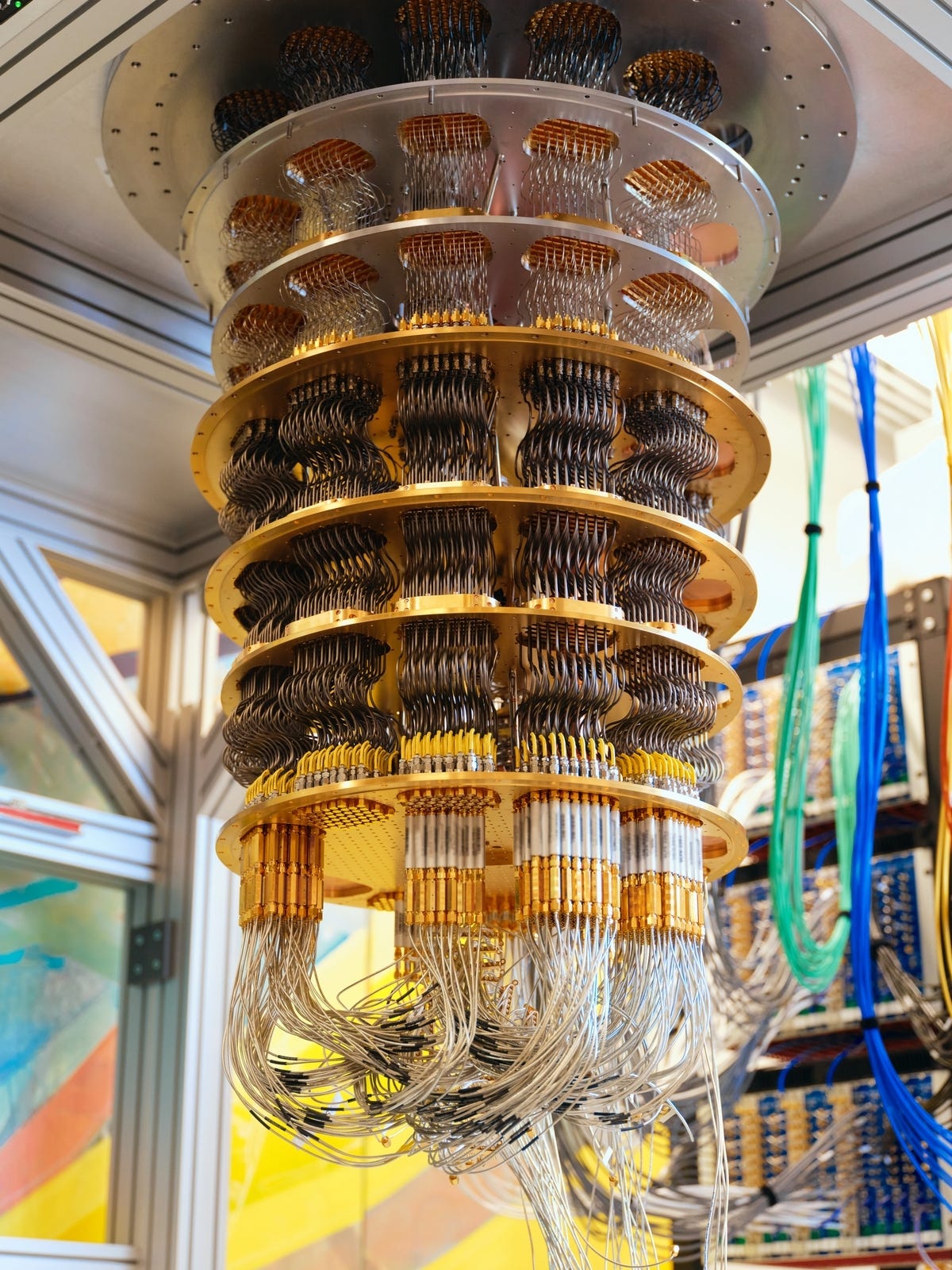
Quantum computing today looks exactly like the 1950s for classical computers. Messy, experimental, many paths, and no clear winner. Here are a few of the quantum computer architectures that have promise today:
Superconducting qubits (IBM, Google): tiny electrical loops cooled near absolute zero temperature; great for fast operations but need complex refrigerators.
Trapped-ion qubits (IonQ, Quantinuum): individual charged atoms floating in electromagnetic traps; incredibly precise but slower and harder to scale.
Neutral-atom qubits (Pasqal, QuEra): clouds of atoms held by lasers like “optical tweezers”; naturally scalable if the control improves.
Photonic qubits (Xanadu, PsiQuantum): use particles of light bouncing through optical circuits; works at room temp but photon sources are tricky.
Silicon spin qubits (Intel): use single electrons in silicon; very early, but if they crack fabrication, it could scale like normal chips.
It looks very similar to the classical era’s competing ideas. Each has strengths. Each has huge engineering challenges.
The timeline for silicon-based chips was roughly:
1950s: idea and first primitive devices
1960s: early prototypes, not yet dominant
1970s–80s: big breakthroughs → commercial dominance
1990s–2000s: global, civilization-scale impact
So roughly 30–40 years from “lab demo” to “giant economic force.”
Quantum computers today feel like they’re somewhere between 1955 and 1965 in transistor terms. Real demos exist, the physics is proven, but scaling them is brutal. One of the architectures will win out one day, but no one knows what it will be yet. But the one that scales the best, will no doubt become the winner.
What Problems do Quantum Computers Solve?
You can categorize it into 2 breakthrough technologies:
Materials Engineering: macro-scale quantum design
Molecular Engineering: micro-scale quantum design
I will briefly touch on some of the exciting technologies that could be discovered. However, keep in mind these are all speculative, some of these may be wildly successful, and others may find no success. But it is safe to say at least some of these will become a reality one day.
Materials Engineering Breakthroughs
Major Improvements in Energy and Physical Transportation with Room-Temperature Superconductors
Quantum computers will allow us to design, simulate and build room-Temperature superconductors with ease.
These materials have zero electrical resistance at room temperature and ambient pressure.
It would be a revolution in physical transportation, recouping heat losses in motors, generators, and transformers.
It would make magnetic levitation trains much cheaper and more reliable, allowing them to go mainstream.
They can improve energy transportation as well, recouping 5-10% that is lost in the electrical grid to heat.

Ultra-efficient batteries
Better designed cathode and anode materials, giving 5-10x higher energy density, a longer lifespan, and less degradation.
Quantum-designed electrolytes and coatings would let ions move fast without damaging the battery, which means safer EVs, much faster charging, and batteries that last longer.
Quantum computers can discover solid-state, multivalent-ion, sulfur, lithium-air, and metal-air batteries by simulating reactions classical computers can’t. This unlocks battery chemistries that are lighter, cheaper, more stable, and far more efficient than anything available today.
Quantum-Designed Solar Panels
Quantum modeling can reveal the ideal layer combinations for multi-junction solar cells that capture UV, visible, and infrared light simultaneously, enabling 40–60% efficiency instead of today’s 20–22%.
New Materials Engineered from Scratch
Material design is largely trial and error today, with help from classical computers creating computational approximations of the material properties. This is a very slow and iterative process. With quantum computers, new metals, new plastics, and new composites will be created that are stronger, lighter, and cleaner than anything we can make today.
This will lead to breakthroughs in construction, aerospace, and manufacturing.
Molecular Engineering Breakthroughs
Super Fast Drug Discovery
All chemistry is quantum mechanics, and drugs work because electrons in molecules interact with electrons in proteins and receptors in your body.
Classical computers cannot simulate this beyond the simplest molecules. A powerful quantum computer will be able to predict drug effectiveness before synthesizing it, design drugs for individual genetics, and reduce drug development from 10 years to a few months.
Catalysts for Agriculture, Environment, Food
Improved carbon capture with quantum-designed molecules that can bind to CO2 more strongly.
Quantum-designed chemical catalysts that could create nitrogen at room temperature, creating cheap, efficient fertilizer for agricultural crops.
Create plant immune-boosting molecules for agriculture, rather than toxic chemical pesticide sprays
Commercial Availability
Quantum computers are a new type of computer that operates on the physics of the world. They’re simply what you get when you unlock efficient simulation of quantum systems, which are the foundation of biology, chemistry, and physics.
With traditional computers, we have only been able to approximate the real world, which has led to innovation being iterative and slow through trial and error.
Quantum computers will allow us to design and simulate the exact molecular structure we want, and then build it in the real world. We will become masters of building in the physical world due to this new technology.
When will they be here? I have no clue. Experts are saying ~20 years until we have practically useful quantum computers. It could end up being 10, or it could easily be 40. It’s really hard to know because there are multiple architectures being tested.
But for now, at least you understand why quantum computers are so exciting. Unless you want to work in the field, or you’re afraid of your Bitcoin getting hacked, you can check back in 5 or 10 years. It’s very unlikely there will be any significant developments until then!